
Barndominium financing in Texas
Financing a barndominium is not harder than financing a house. It is different, and the difference shows up early. If you line up the lender before the plan, most of the friction goes away.
Last updated:
You are not getting a mortgage first
A mortgage buys a finished house. Nothing is finished yet, so what you need is a construction loan that converts to permanent financing when the building is done. That product is usually called construction-to-permanent, and it is one closing instead of two.
The loan funds in draws against completed work. Deposit, slab, steel delivered, dried in, rough-in, substantial completion. An inspector verifies each stage before the bank releases money, so the draw schedule in your contract needs to line up with the one in your loan.
If your builder's draw schedule and your lender's draw schedule do not match, somebody is fronting money. Usually the builder, until they stop.
Where the money usually comes from
Local and community banks
This is the most common path in North and East Texas. A bank that has funded barndominiums in your county already knows the appraisal problem and has a way through it. A national lender that has never seen one will spend six weeks discovering it.
Ask one question on the first call: have you funded a barndominium in this county in the last two years. If the answer is no, keep calling.
Farm credit lenders
Agricultural lenders finance rural property and improvements as a matter of routine. If you are building on acreage, they often understand the collateral better than a residential lender does.
USDA rural development
If the property is in an eligible rural area and your household income fits the limits, USDA programs can work. Eligibility is by address and by income, so check both before you plan around it.
Land equity
If you already own the land free and clear, that equity often counts toward your down payment. That single fact changes what a lot of people can afford, and plenty of buyers never ask about it.
Cash and phased builds
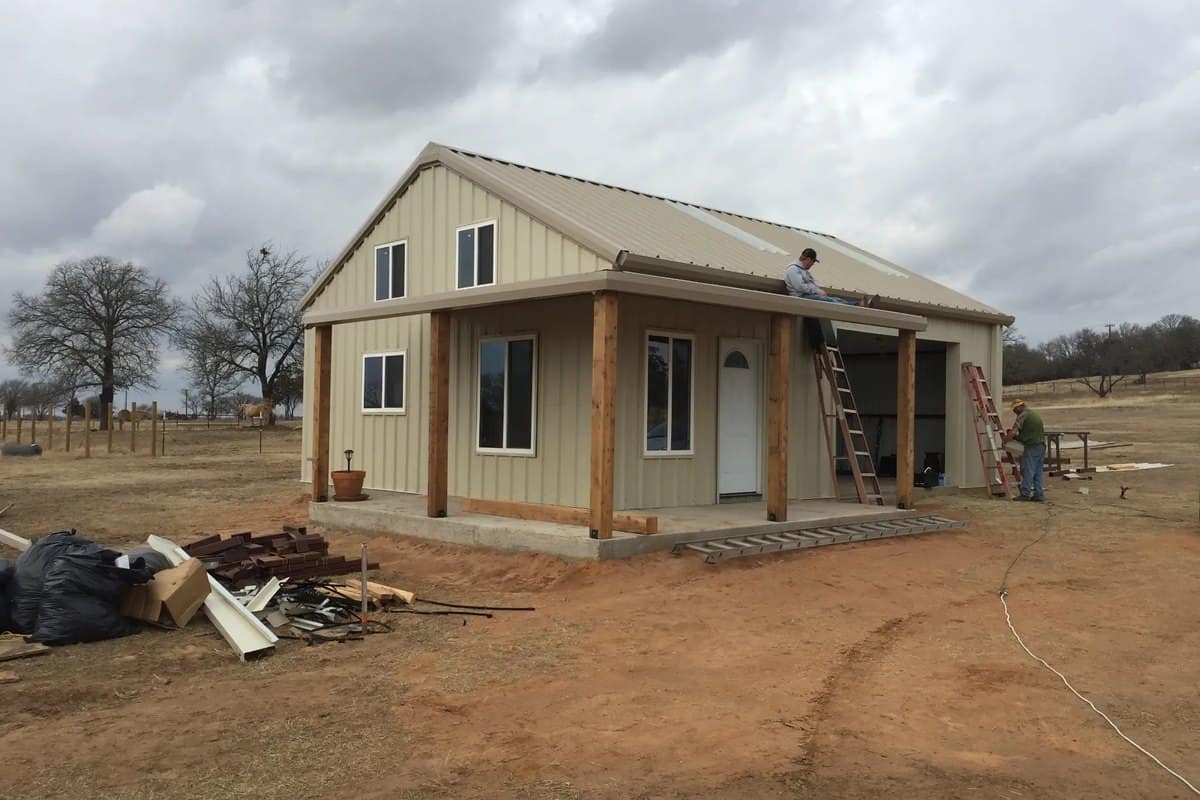
Some people build a dried-in shell at $62 - $78 per square foot with cash and finish it in phases. That works if you are disciplined and if the shell is genuinely weather tight. It goes badly if the plan is to live in it while finishing it around a full time job.
The appraisal is the real hurdle
An appraiser values your building against recent sales of comparable properties. In rural counties where barndominiums are common, those comparable sales exist and the appraisal comes in fine. In a neighborhood where yours would be the first one, they do not, and the appraiser has to reach.
If the appraisal comes in under the build cost, the bank lends against the lower number and you cover the gap in cash. That is the scenario worth knowing about in month one rather than month six.
- Ask a local agent what barndominiums have sold for in your county in the last year.
- Ask your lender whether their appraiser has valued one before.
- Keep the plan conventional enough to be comparable. A wildly custom building is harder to value.
- Do not over-improve for the area. A high finish build in a low comparable market is the classic appraisal gap.
What a lender wants from you
- A signed construction contract with a fixed price and a written scope.
- Full plans and engineered drawings, not a sketch.
- A draw schedule tied to milestones.
- Builder documentation: insurance certificates, references, and evidence the builder is real.
- Your financials, the same package any mortgage wants.
- A land survey and title work.
- A contingency, usually five to ten percent, that the bank wants to see funded.
Lump sum against a written scope helps you here. Cost-plus makes a lender nervous because there is no fixed number to lend against, and some will not fund it at all.
What it costs to carry the loan
During construction you typically pay interest only on the amount drawn, not the full loan. That means your payment starts small and grows as the building goes up. Budget for it. On a build that runs seven to eleven months, that is most of a year of payments while you may also be paying rent or an existing mortgage.
On a 2,500 square foot mid finish build at $145 - $172 per square foot, you are financing $363K to $430K for the living area alone, before land and site work. Run the carrying cost on that before you sign anything.
Land, septic and the rest of the budget
A construction loan funds construction. Land, well, septic, driveway and utility extension may or may not be inside it depending on the lender and how the loan is structured. Ask specifically, item by item, because assuming is expensive.
On raw land those items routinely run $30,000 to $100,000 or more. If they sit outside the loan, that is cash you need on hand.
Insurance
Builders risk insurance covers the structure during construction and your lender will require it. After completion, a steel framed home insures like any other home, and some carriers rate it favorably because steel does not rot and does not burn the way wood does.
Get a quote before you build, not after. Carrier appetite for rural acreage varies and it is better to know your annual premium while you can still adjust the plan.
What happens at the end of construction
The final draw is not released until the bank's inspector signs off and, on permitted work, the jurisdiction has done its final inspections. Some lenders hold retainage, usually five to ten percent, until lien waivers are in hand from the builder and the major subcontractors.
Lien waivers matter more than people expect in Texas. A subcontractor who was not paid can file against your property even if you paid your builder in full. Ask for conditional waivers with each draw and unconditional waivers when the draw clears. Any builder who balks at that is telling you something.
At completion the loan converts to permanent financing. On a true construction-to-permanent product that happens without a second closing and without a second set of closing costs. On a two-loan structure you close again, pay again, and you requalify at whatever rates exist that month. Know which one you signed.
You will also need a final survey and a certificate of occupancy where the jurisdiction issues one. Both are routine. Both take longer than you think if nobody ordered them until the week they were needed.
The order to do this in
- Talk to two or three local lenders before you finalize a plan.
- Confirm the appraisal picture in your specific county.
- Get the land question settled, including septic and water.
- Get a real construction number against a written scope.
- Then design to the budget the lender confirmed, not the one you hoped for.
Most people do this backwards. They design first, fall in love, then find out what the bank will actually fund. Reversing that order is free and it saves months.
Questions
Can you get a loan for a barndominium in Texas?
Yes. Most people use a construction-to-permanent loan through a local or community bank that has funded barndominiums in the area. Farm credit lenders and USDA rural development programs are also common paths.
Why do banks have trouble financing barndominiums?
Appraisals. An appraiser needs recent comparable sales, and in areas where barndominiums are unusual those sales do not exist. In rural counties where they are common, this is rarely a problem.
How does a construction loan work for a barndominium?
It funds in draws against completed milestones: deposit, slab, steel delivered, dried in, rough-in and substantial completion. An inspector verifies each stage. You typically pay interest only on what has been drawn, then it converts to permanent financing at completion.
Can I use my land as a down payment?
Usually yes, if you own it free and clear. Land equity often counts toward the down payment requirement, which changes what a lot of buyers can afford.
Does a construction loan cover the septic system and the well?
Sometimes. It depends on the lender and how the loan is structured. Ask item by item, because on raw land those costs routinely run $30,000 to $100,000 or more and you need to know whether that is cash out of pocket.
Do lenders require a fixed price contract?
Most do. A lump sum contract against a written scope gives the bank a number to lend against. Cost-plus makes lenders nervous and some will not fund it.
Keep reading
Barndominium cost in North and East Texas
What a barndominium costs per square foot by finish level in DFW and East Texas, what the land costs on top of it, and where people get their budgets wrong.
What a slab actually costs
Foundation cost per square foot in Texas by loading, why Blackland clay changes the design, and why leaving the slab out of a quote makes it look cheap.
Metal building permits in Texas
Who issues the permit, what a Texas jurisdiction actually wants to see, what changes outside city limits, and what the whole process costs in time.
Barndominiums or see every published price. Permitting and soil change town by town, and every town we build in has its own page.
Get a number
Reading is cheaper than guessing
Tell us what you are building and we will price it against a written scope. Or call 469-721-0196.